
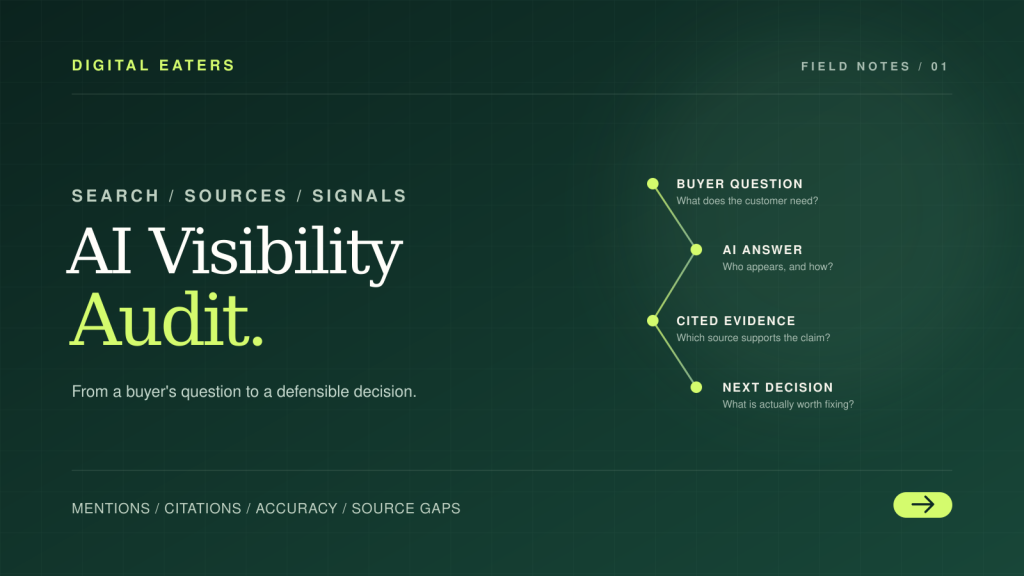
An AI visibility audit is a structured check of how services such as ChatGPT search, Google’s AI features and Perplexity describe your business when people ask relevant questions. A useful audit records more than whether your name appears. It checks whether you are recommended, whether your website is cited, whether the description is accurate, and which sources support competing answers. The result should be a short list of fixes backed by observed evidence—not a mysterious “AI authority score.”
That last distinction matters. Imagine asking an AI assistant to recommend firms in your industry. It names two competitors and links to a trade publication. Your company is absent. The tempting response is to publish ten articles or buy a mention on that publication. But the missing piece might be a service page, a contradictory business description, an inaccessible URL—or simply a question for which your company is not a good fit.
Here is a method for telling those situations apart.
At a glance: an audit worth acting on
- Test questions that resemble real buying decisions—not just your brand name.
- Record mentions, recommendations, citations and accuracy separately.
- Inspect the pages AI answers actually link to, including independent sources.
- Check technical eligibility before prescribing more content or outreach.
- Repeat the same questions after changes, and report uncertainty honestly.
First, decide what you mean by “visible”
AI visibility is often discussed as though it were a single ranking. It is not. Different questions, products, locations and answer surfaces produce different experiences. One answer may name your company without linking to it. Another may cite your research without recommending your services. A third may confidently repeat an old price or an unsupported claim.
For an initial audit, we find it useful to keep four observations apart:
| Signal | What to record | What it does not prove |
|---|---|---|
| Brand mention | The answer names the correct company. | That the answer endorses it or used its website. |
| Recommendation | The company is suggested as a suitable option for the stated need. | That it will be recommended to every user. |
| Website citation | A visible source link points to a page on the company’s domain. | That the company itself was recommended. |
| Factual accuracy | Claims about services, location, pricing or capabilities agree with verifiable current facts. | That the answer is complete or commercially useful. |
Be especially careful with the word citation. A link to an independent article that mentions your company is not a citation to your own website. Both may matter, but they are different observations. Likewise, a source link shows what an interface presented as support; it does not reveal an AI system’s entire internal decision process. OpenAI itself advises readers that search citations may be incomplete, outdated or wrong.
Start with a question set, not a dashboard
Before opening any tracking tool, write down the market you intend to measure. A regional accounting firm, for instance, should not be judged against the same questions as a global finance-software platform. Record the service category, buyer type, country or city, language and a few genuine alternatives customers consider.
Then build a small, fixed set of questions. Fifteen is a reasonable working starting point for a manual diagnostic—not a statistically representative sample of every AI interaction. Keep the first 12 unbranded so you can examine whether a buyer could discover you without already knowing your name. Reserve three branded questions for checking factual accuracy.
A 15-question starter set you can adapt
The examples below use an imaginary business that provides payroll support to smaller employers. Replace the category and constraints with the language your actual customers use.
| Buyer stage | Example question |
|---|---|
| Problem and criteria | What should a 30-person company check before outsourcing payroll? |
| When does outsourced payroll make more sense than handling it in-house? | |
| What questions should an employer ask about payroll data security? | |
| What tends to go wrong when a growing business changes payroll providers? | |
| Shortlist and comparison | Which payroll providers support small employers in [target region]? |
| What are good payroll options for a company with both office and hourly staff? | |
| How should a small business compare local payroll specialists with national providers? | |
| Which providers explain onboarding, support and data handling clearly? | |
| Decision and evidence | What should be included in a payroll service-level agreement? |
| Where can I find reliable comparisons of payroll support for small employers? | |
| Which payroll providers publish useful implementation guidance? | |
| What evidence should I look for before choosing a payroll partner? | |
| Branded accuracy checks | What services does [your company] actually offer? |
| Does [your company] work with employers in [target region]? | |
| What are the documented limitations or requirements of [your company’s service]? |
The questions are not meant to trick an assistant into naming your brand. They are meant to expose the real moments when somebody needs advice, a shortlist or proof. If a prompt assumes something untrue about the business, change it. That false premise would make the audit less useful.
Preserve the answer before interpreting it
Run your question set in the AI experiences relevant to your customers. ChatGPT with web search, Google AI Mode, an AI Overview when one appears, and Perplexity are possible starting points. They are not interchangeable. A standard chat response without live retrieval is not the same observation as a search-enabled response with cited pages.
For each completed response, save the full answer, the visible source links and the conditions under which you received it. Record the date, market, language, product surface, search mode and any meaningful account or personalization setting. If a request fails, mark it as failed; do not count it as a case where your brand was absent.
Keep one unchanged core question set for comparing later audits, plus a separate exploratory list for new questions you discover. For especially important buying prompts, run them more than once and show the number of completed runs. An isolated screenshot is a clue, not a market-wide benchmark.
The evidence ledger
A spreadsheet with one row per completed answer is enough to begin. These fields make the findings reviewable by someone who was not present during testing:
| Field | Example entry |
|---|---|
| Prompt / intent | P06 · unbranded shortlist |
| Surface / context | ChatGPT search · UK English · 30 Oct 2026 |
| Result / evidence | Complete answer saved; source URLs copied |
| Brand outcome | Not mentioned; not recommended |
| Source classification | Competitor page; independent trade guide |
| Accuracy or relevance issue | Trade guide covers larger employers only |
| Next verification | Check whether our small-employer page covers this use case |
The entry above is illustrative, not the result of a Digital Eaters client study. Its value is the relationship between an observed answer and the question you would check next.
Calculate four rates—and keep their denominators visible
You do not need a proprietary “AI visibility score” to communicate the baseline. For the unbranded question set, count completed responses and calculate:
- Mention rate: completed unbranded answers naming your business ÷ all completed unbranded answers.
- Recommendation rate: completed unbranded answers presenting your business as a suitable option ÷ all completed unbranded answers.
- Owned-site citation rate: completed unbranded answers containing at least one visible link to your domain ÷ all completed unbranded answers.
- Accuracy check: number of material company claims verified, contradicted or not verifiable, evaluated primarily from the separate branded questions.
Show the counts alongside the percentages. “Two mentions in 12 completed answers” says more than “16.7% AI visibility,” particularly when your test set is small. If you test several products or regions, report each separately before considering a combined view. An average can hide the fact that you are well represented for educational questions and invisible when buyers ask whom to hire.
Also resist the urge to equate citations with leads. A citation is an exposure event, not proof of a click, an enquiry or revenue. Those outcomes deserve their own tracking.
The important part: trace the source gap
Once you know where your company is missing, read the pages that the answer did cite. This is where the audit moves beyond visibility monitoring and begins to inform content strategy and authority building.
For each high-value prompt, ask five questions:
- What job was the answer trying to do? Explain a process, compare options, check a fact, or recommend a provider?
- What kind of source supported it? A vendor page, independent guide, official documentation, customer review, directory, specialist publication, or original research?
- What useful evidence does that page contain? A clear definition, current service details, documented test, expert interview, practical comparison, or something else?
- Do we have equivalent evidence? If yes, is it easy to find and understand? If no, can we honestly produce it?
- Is this an appropriate place for our business to appear? Would the reference help that publication’s audience, even if search engines and AI assistants did not exist?
The fifth question is easy to skip, especially when a competitor has already been mentioned. It is also the one that keeps a source-gap exercise from turning into indiscriminate link buying. A cited publisher may be worth studying but wholly unsuitable for outreach. An industry association may have membership rules. A comparison writer may include only services they have independently tested. A directory might contain old, scraped information. Treat each according to its editorial context.
Four gaps that can look identical in an AI answer
| What you observe | What to inspect before acting | A defensible next step |
|---|---|---|
| Competitors appear for a specific service, but your site has no focused page. | Whether the service genuinely belongs to your offering, and whether customers need a dedicated explanation. | Improve the appropriate service page, supported by specific capabilities and limits. |
| An independent publication is repeatedly cited, but it leaves you out. | Its audience, selection criteria, freshness and whether your business truly fits the story. | Offer useful information or a legitimate editorial angle where welcomed; accept that inclusion is the publisher’s decision. |
| Your brand is named but described incorrectly. | Your own pages, profiles, old directories and the visible source behind the claim. | Correct the primary fact, then address outdated references at their source. |
| Your page is useful but never appears as a source in the tested answers. | Search eligibility, crawl access, internal discovery, relevance and competing evidence. | Resolve confirmed access or content problems, then retest rather than assuming a single cause. |
Make a one-page source of truth for company facts
A citation audit can reveal that the web is telling several versions of the same business story. Before trying to correct each listing separately, write an approved fact sheet: the trading name and canonical website; what the company does and does not offer; the customers and locations it serves; current product or service limitations; and the public page supporting each claim.
Keep the legal or invoicing entity separate from the public-facing trading brand where they differ. A registered billing address is not necessarily a customer-facing office or a service location. These distinctions can be important for international businesses, and flattening them into one vague “headquarters” claim can introduce the very confusion the audit is meant to remove.
Use this fact sheet when reviewing your own site, major profiles, directory entries and cited third-party articles. It gives the team a consistent standard for deciding whether an answer is wrong, outdated or merely incomplete.
A genuinely useful independent reference can strengthen the public evidence surrounding a company. But relevance, editorial standards and factual fit matter more than simply finding a domain that an AI tool once cited. That is the reasoning behind relevance-led authority building: the source should make sense to a human reader first.
Check whether important pages are technically eligible
Source quality does not rescue a page that the relevant systems cannot access. Before commissioning new articles, have your SEO or development team check the pages that ought to support your key questions:
- Do the canonical URLs load successfully, and are they internally linked from sensible places?
- Are they indexable, with no accidental
noindex, restrictive snippet instruction or conflicting canonical? - Can the relevant crawler access the page through
robots.txt, the CDN and any security rules? - Are the important facts visible in accessible page text, rather than buried in an image or inaccessible interactive widget?
- Do company names, services and other structured facts agree with what the visitor actually sees?
The crawler distinction is worth checking carefully. OpenAI’s publisher guidance identifies OAI-SearchBot as relevant to discovery for ChatGPT search and distinguishes it from GPTBot, associated with potential training. They serve different purposes. Do not change your training preferences on the assumption that doing so is a shortcut to getting cited.
For Google AI Overviews and AI Mode, Google’s 2026 guidance places the emphasis on ordinary search eligibility, crawlable content and genuinely useful information. It explicitly says you do not need a special llms.txt file, a special AI schema type or a formula for chopping articles into tiny text blocks to appear in its AI search features. Structured data can still be useful where appropriate, but it should match the page, not manufacture evidence.
That is also why on-page work belongs in an AI audit. Clear service architecture, accurate headings, natural internal links and proper canonicals are not glamorous. They are the foundations on which later SEO improvements and external recognition depend.
Use the first-party reporting that now exists
Manual prompt testing tells you what a selected user experience displayed. Webmaster and analytics tools answer different questions, and in 2026 they offer more AI-specific information than they once did.
Google Search Console: generative AI performance
Google introduced dedicated generative AI performance reports in Search Console in June 2026 and reported worldwide rollout by the end of August. The reports provide a way to examine impressions and participating pages for its AI features, with country, device and date breakdowns where applicable. That information is also part of overall Search performance; it should not be mistaken for an independent count of every time an AI assistant recommended your company.
Use it to see which URLs surface and where. Use the manual answers to check what those appearances mean for a real buyer question.
Bing Webmaster Tools: cited pages and topic opportunities
Bing AI Performance reports citation activity for your pages in supported Microsoft AI experiences. Its expanded reporting includes grounding-query context, topics and comparison views. In October 2026, Microsoft added a Topics Portfolio beta that can surface queries where other sources appear and your site does not.
That sounds close to a ready-made content plan, but Microsoft calls the beta figures directional. Topic classifications can be imperfect, some smaller sites may lack sufficient data, and an opportunity query can include another brand’s name. Read the underlying query before assigning an action.
Analytics: visits are a separate layer
Track identifiable AI referrals and the business outcomes they produce, but do not expect every answer exposure to become a visit. OpenAI notes that ChatGPT search referrals can carry utm_source=chatgpt.com, which can help with attribution. Referrer visibility, attribution and consent settings vary, so label the numbers as observed visits rather than total influence.
Together, these sources give you three different lenses: observed answers, search-platform visibility, and website behavior. None is a complete substitute for the others.
Turn the findings into a decision, not a task pile
A typical audit produces more possible improvements than a team can reasonably make. The answer is not to assign each item a dramatic urgency label. It is to ask what is supported by evidence, what matters to buyers and what can be verified after a change.
For every proposed action, record:
- Observation: the exact prompt and dated answer that revealed the problem.
- Interpretation: your best explanation, labeled as a hypothesis if causation is uncertain.
- Importance: why this issue affects a real buying question or reputational fact.
- Action and owner: the smallest credible fix and the person responsible.
- Verification: how you will confirm that the factual, technical or editorial change is live.
- Retest: when and under which conditions you will rerun the original question.
Consider two findings. The first: an AI answer says the business no longer serves a region, even though the company’s current page says it does. Correcting that misinformation deserves attention now. The second: a general article cites a large publisher whose audience is unrelated to your business. Pursuing that publisher may have little value, no matter how impressive its metrics look.
Those are not the same job. One requires a fact check. The other may require no action at all.
A practical first-month rhythm
- Days 1–3: Establish the baseline. Agree on market scope, questions and collection settings. Save the first complete answer set and review the facts.
- Days 4–7: Inspect the evidence. Review recurring cited sources, key service pages, technical eligibility and mismatched brand information.
- Days 8–21: Make selected corrections. Fix confirmed technical or factual issues first. Commission content or pursue editorial opportunities only where the research reveals a genuine need.
- Days 22–30: Verify and schedule the retest. Confirm fixes are live, record what changed and rerun the stable questions when the affected systems have had a reasonable chance to process the changes.
Thirty days is an operating plan, not a promise that AI systems will update in that period. Some changes may appear quickly; others may take longer or never change the observed answer. Keep the unchanged baseline so the eventual comparison is honest.
What the finished audit should leave on your desk
After all the screenshots and checks, a useful deliverable can be surprisingly short. It needs a defined question set, saved responses, four separate visibility observations, a source-gap review, verified technical findings and a prioritized action log. Each important conclusion should point back to something another person can inspect.
If an agency cannot show you the exact question, answer, cited page and reasoning behind its proposed work, ask for that evidence before approving a campaign. The point of a sound research and review methodology is to make the next decision clearer—not to hide uncertainty behind a chart.
Frequently asked questions
What is an AI visibility audit?
It is a repeatable assessment of how AI-assisted search experiences mention, recommend, cite and describe a business for relevant questions. It combines observed answers with source, content and technical checks so the business can decide what to improve.
Can I check whether ChatGPT recommends my business for free?
Yes. Begin with a small set of realistic unbranded customer questions in ChatGPT search, save the answers and sources, and record the date and context. Add branded questions to check factual accuracy. The result is a useful manual baseline, not an exhaustive measure of all ChatGPT users.
What is the difference between an AI mention and an AI citation?
A mention names a business in the answer. A citation is a visible source reference, typically a link to a page supporting some part of the answer. An answer can mention a company without citing its website, or cite its content without recommending its services.
What is a good AI visibility score?
There is no universal percentage that makes a company “good” at AI visibility. Results depend on the questions selected, the platform, market and time of testing. Compare like-for-like question sets, report actual counts, and focus on whether important buyer needs are represented accurately.
How often should an AI visibility audit be repeated?
A monthly check of the same high-value questions is a practical starting rhythm, with additional reviews after important product, service or location changes. Verify urgent factual and technical fixes as soon as they are deployed. Keep each historical baseline so results can be compared fairly.
Do backlinks, schema or an llms.txt file guarantee AI citations?
No. Relevant editorial references may make a business easier to discover and evaluate, while correct structured data and technical SEO can support website clarity. None controls whether an AI system recommends or cites a page. Google specifically says a special llms.txt file or AI-only markup is not required for its generative search features.
Do I need a paid AI visibility tracking tool?
Not for the first small audit. A fixed question list, a spreadsheet, saved responses and free webmaster reports can establish a defensible starting point. Automation becomes more useful when you need to monitor many questions, markets or brands. Before paying, check which AI product surfaces a tool actually tests, what it preserves as evidence and how it handles changes in search behavior.
The principle to keep
Do not start by asking, “How do we get mentioned more?” Start with, “What would a useful, accurate answer need to know about us, and where could it find credible evidence?” The first question tends to produce activity. The second gives you something worth improving.
That is the value of an AI visibility audit: it connects a buyer’s question to the evidence available on the web, then tells you which changes are justified—and which are merely guesses.